
IN DISCUSSION: Sophie Snow
Featured Maker Summer 2026
Interview by GRACE WOLFE
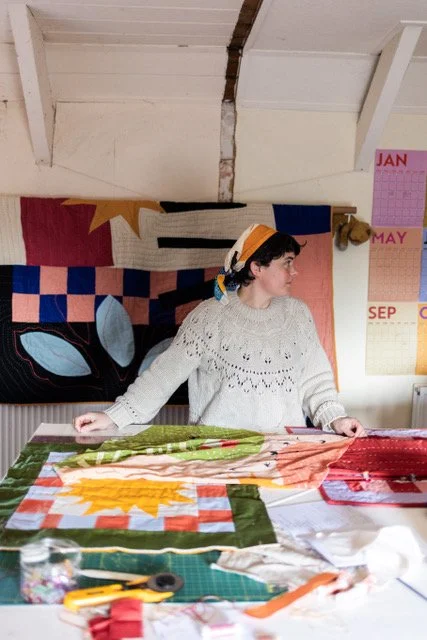
Sophie Snow is a Pembrokeshire based textile artist known for her hand appliqued renditions of traditional Welsh landscapes. She combines rural coastlines with East Asian stitching techniques and fabrics to create quilts, scarves, and framed textile pieces.
Based in St Dogmaels, West Wales, Sophie Snow is a textile designer and quilter inspired by the landscape around her home. After more than ten years working in the fashion industry as a print designer, Sophie returned to her own creative practice and a love of craft.
Working with colour, shape, pattern and texture, she creates distinctive one-off textile pieces that bring together contemporary design and traditional quilting techniques. Each work reflects her playful approach to making and her connection to the Welsh landscape.
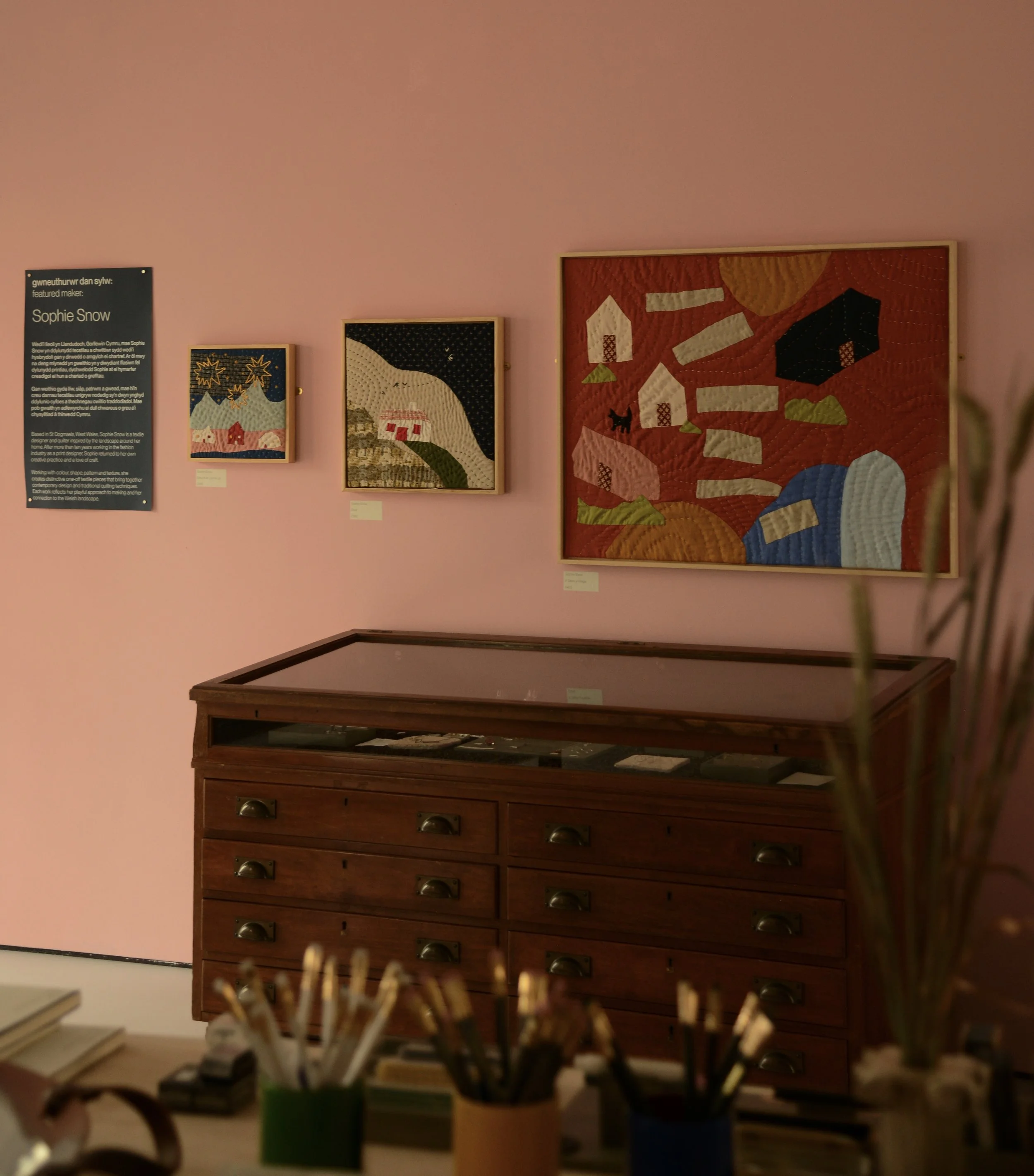
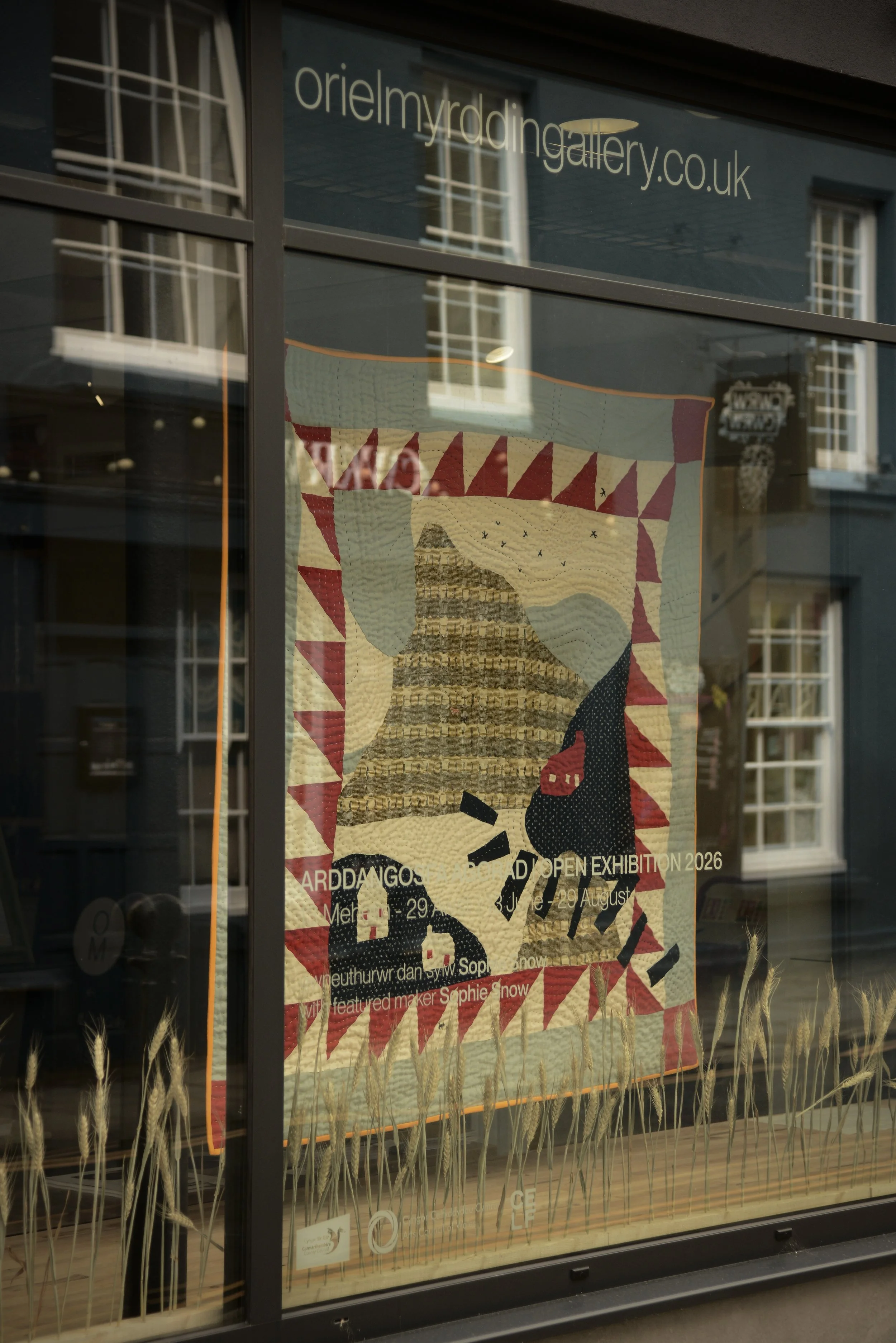
Sophie Snow’s work is on display and available to purchase from Oriel Myrddin until August 29th.
Photography by Kate Dunwell
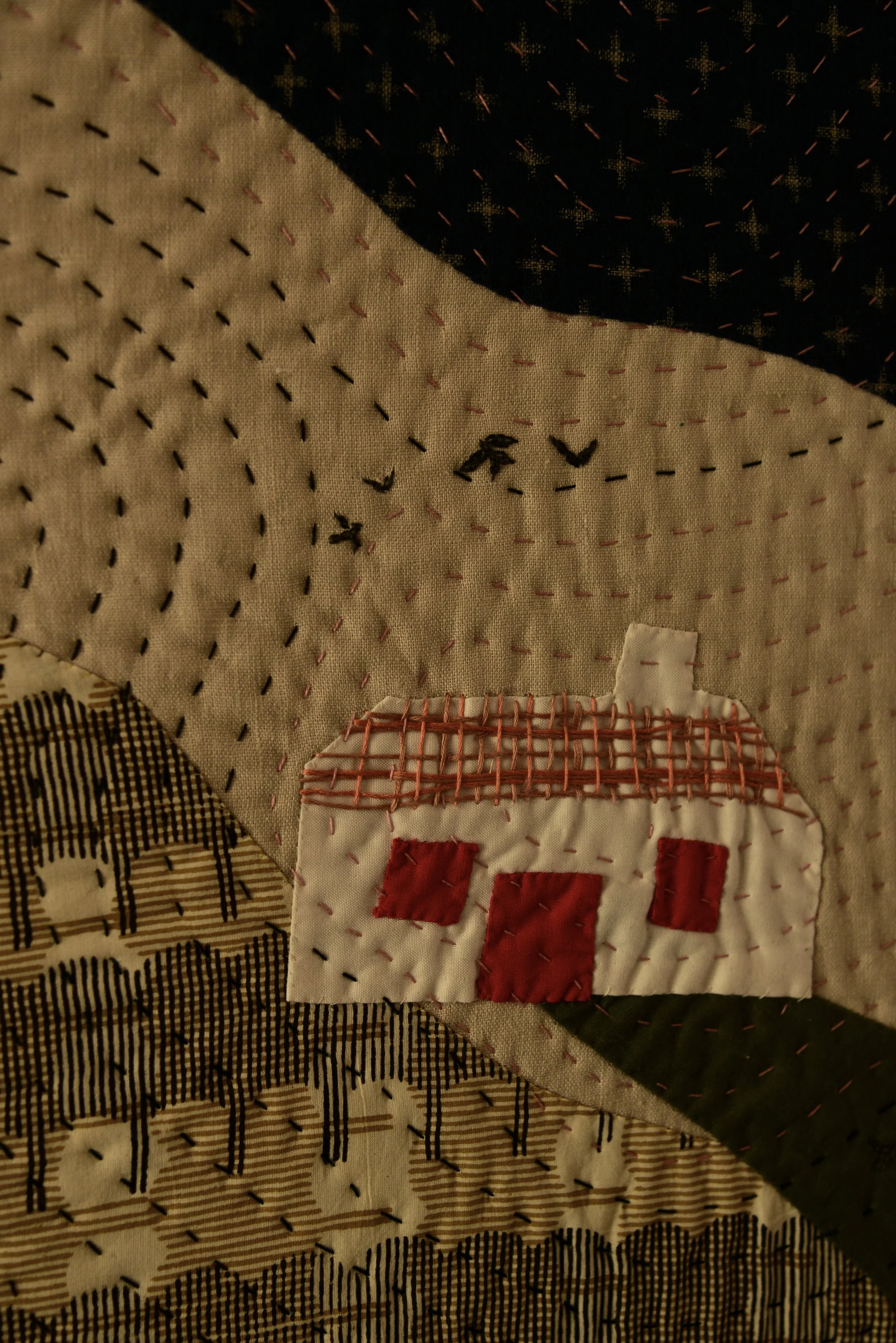
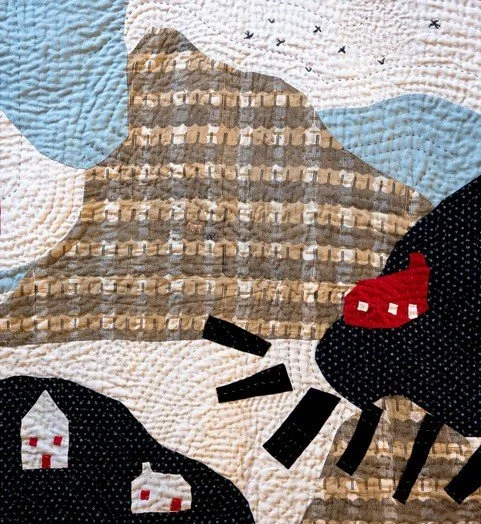
‘Edrych lan | Look up’ by Sophie Snow
Hey Sophie! You’re currently based in Saint Dogmaels, one of the most historically rich villages in Pembrokeshire, how do the local surroundings impact your work?
Well, when you see my work, it is all about scenery. The coastline that surrounds the village, the estuary, all the wildlife as well. I would say it is generally from just my everyday life there, dropping off the kids to school, picking up the kids from school, going to the market, that's every Tuesday, and immersing myself within St Dogmaels.
What wildlife are you particularly drawn to?
Sophie: Birds, I love birds. I've got a collection looking at migration. It was looking at the way birds move. It sounds very literal now, but flying, how they travel from place to place. The chickens in the road, and the horses that are climbing the local mountains and things like that. It's looking at the everyday things that we take for granted not necessarily because we mean to, but because we're so used to seeing them every day.
I read you studied Three-Dimensional Design at Manchester School of Art and then moved on to achieve a masters in Textile Design in Winchester. I’d love to hear about your educational journey throughout this period. What sort of work were you creating?
I did a foundation here first in Carmarthen, but I really wanted that change from growing up in the countryside to moving into a big urban city. I started off in jewellery and I thought I was going to be a jeweller. But my lecturer kept saying to me, you've got this real textile element to you. I ended up on a 3-week scholarship out in India and obviously just fell in love with their work and techniques. They still come into my work today, which I'm sure we'll touch on later. But that was what started it all off for me. After coming back, I said to my tutor ‘I think I need to go straight into a masters, and I think I need to change disciplines.’.
So how has your work evolved since your masters?
I was doing my master's at a time when the recession had badly hit the UK. We were being pushed into industry, pushed into contracts, pensions, mortgages, because the world was so unstable. But I did learn a lot. I've always been into my fashion. My style and clothing, like jewellery, is all kind of tied together. So only being 22, I was quite happy to go out, get a job, and to kind of experience the fashion industry. I was hungry to make my stamp on this world, and I did. I ended up in High Street Fashion. I had some lovely colleagues, but I was churning out something like 15 prints a day, all on a computer. The creativity had gone. One day somebody just threw a Topshop dress at me and said, ‘Can you just do this print exactly like this, just enough for us to not get sued.’. Then she turned around to me, and just said ‘well, actually, it doesn't really matter for me, because you're the one that's going to get sued.’. I just remember being like, ‘I can't do this. This isn't what I set out to do.’ So, I ended up leaving. I just realised I needed some time to create.
After working in the fashion industry for such a large portion of your life you established your own independent practice. Does this time in fashion still influence your work?
Definitely. I was a printmaker for years. It's helped me to find a focus. It's helped me really kind of hone my colour, but also how to source my fabrics and stuff properly. I get a lot of people that say to me, I just want to wear one of your worlds and I'd love to do a jacket. But I just can't, I haven't got there yet on that part of the journey, it's going to take time. I have started doing silk scarves, of the original drawings of the quilts. I think every element of our journey is important, whether it was a good experience or a bad experience. You kind of do have to look back and see where it's taken you now.
You spent some time post education travelling, could you talk about where you went and the impact these places have had on your practise?
I did Indonesia. I was looking at Ikat weaving, where you dye your fabric before it goes into the loom and then as you weave it, almost like an image or a style pattern emerges. I've done a lot of Ikat style prints in my career; I just find that style of fabric-making really interesting.
I went to Morocco. Their dye baths are just something else. Oh my God. It's amazing. They have this whole leather work system out there. They dig these massive baths into the ground. It's like a clayish soil. And they just sink loads of leather hides into baths and dry them. And then the Yves Saint Laurent gardens. Morocco was a massive influence on him. And his gardens are incredible. All these different cactuses and things.
As you mentioned earlier, you completed a series of pieces under the collection Migration. It has this Matisse-esque motif of the Swallows. But do you want to get into more of the significance of the title and the swallows to you?
I got into quilting because I got ill with my third pregnancy. I was still working in the fashion industry, but it is so up and down. I was quite frankly, a bit lost. We'd just moved back to Wales. And honestly, we've been moving for a very long time, like years. I've lived in Manchester, Southampton, Oxfordshire, and Liverpool. And then having kids, we decided to come home. But I came home and then realised that I didn't have anything for myself anymore and I didn't know what to do. So, I was talking to my husband about it, and he was like, ‘why don't you make the quilts that you always wanted for your kids?’
While this was happening, my husband was losing his dad. The one thing that he said to me, ‘I just want him to see the swallows come home one more time.’. That's where all that collection came from. It was this idea of coming and going and settling. Just being in a moment of time and appreciating that moment because you don't know when it's going to come and go. So yeah, the swallows still do feature in my pieces, I think they will forever. I think there'll always be a swallow in my work.
Let's talk about Kantha stitching. My mother adores Kantha. She has these huge Indian throws and tapestries. You've adopted the running stitch across many of your textile pieces. What is your relationship with Kantha?
I went to India on a scholarship. They took us out to a traditional Indian tribe women's group for a day to study Kantha. I was just drawn to it. I was almost always buying clothing with it on, bits of furniture with it on, bits of textiles and things like that with a running Kantha stitch. I didn't think anything of it apart from I just really love it, because obviously I was in print at the time. But even looking back, whenever I'm drawing up new quilt ideas and things like that, I'm drawing a kantha stitch in. I am drawing it in from the get-go. It's ingrained in me now. I just love it. You're meant to mark out your lines and do it that way. I just, I just stitch, and I see where it takes me. Sometimes I change my colour. Sometimes I change my cotton. I get a lot of quilters, like traditional quilters come up to me and go, it's not quite right. I don't mind. I suppose it's quite meditative, isn't it? I do it nearly every day. I always have some piece on the go. I just love the effect, the crinkling of the fabric afterwards, how you can change your threads. It's just so much you can do with it. And it's a simple running stitch.
In the current work that you're making, are there any other Indian or Asian practices that you have adopted?
I do use a lot of Japanese fabrics, and I use Indian block prints. When I'm sourcing my fabrics, I always try to find an Indian or a Japanese selvedge sort of fabric.
That's interesting, lots of people who come into the shop often ask about how you source your fabrics.
Sophie: This is a question I get a lot, ‘What comes first, the image or the fabric?’. Because I think for a lot of quilters, they find a fabric they like, and then they quilt it. Whereas for me I start off with a drawing, and then I source the fabrics. Merchant and Mills are very good. Cloth House in London is very good as well. I also enjoy looking at other makers, for example do you guys know Mara Vera Textiles? She's down in Cornwall. She's definitely worth looking at.
You primarily work with cotton, is there a significance in using natural materials for you?
Yeah, because it's just better for the world. I know that's really black and white. I do work with linen a lot more now. The cottons I work with are quite bright, which is great. But I wanted something a bit more muted. And again, even more environmentally friendly. And that's where linen is coming in. I’ve been making linen banners using fabrics from Wild Linens in Bristol. I do still work with cotton; I like using it for applique as it's got a nice stiffness to it.
Are there any materials you've yet to work with that you'd like to experiment with or work with, in the future?
I love denim. A lot of people ask me if I would ever get into Sashiko embroidery. Would I ever go from the running Kantha stitch into Sashiko. It's such a lovely idea and it works so well with denim. But I don't know how yet. You could do anything as a working artist, can't you? So, it’s almost like trying to find a way that it works for you.
You’ve previously collaborated with Ein Cegin, a community kitchen in West Wales. What did this involve?
Ein Cegin approached me after the Cardigan Craft Festival as they had some funding. They do creative projects as well as cooking projects, and they needed some decorations, some banners for a new Cardigan Farmer's Market. The Guild Hall in Cardigan had a massive reinvention, like a renovation job. To celebrate it, they've brought back a bimonthly producer's market. Which is great, organic veg, fish, meat, you name it. We ran a series of workshops with Flying Start, which is for young families from working backgrounds to give them an opportunity to learn about food and how to cook off a modest budget. But also, to create. We created two banners on what does the market mean to you? We were looking at the heritage of the town, food, where food comes from, and the wildlife.
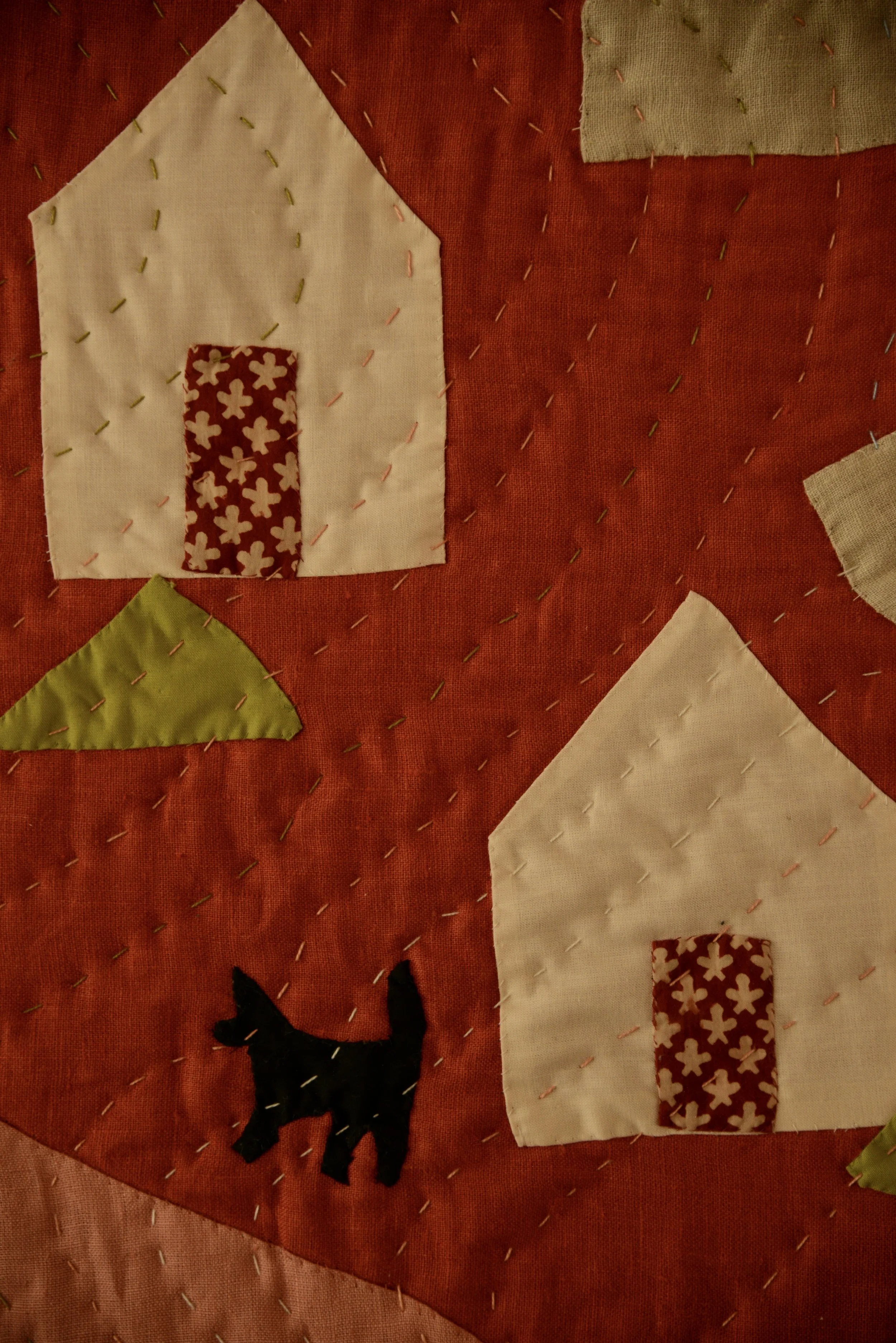
Your collection of works currently featured in the Oriel Myrddin shop showcases colourful rural landscapes adorned with farmhouses. What is your process when designing your pieces before you pick up a needle and thread?
I collage, I draw, I paint. I go for walks, I’ve got a German pointer dog and she is my life. It’s just wandering. I look at the houses that are abandoned, because you can’t help but wonder what was there, and almost from that point, I create my own story. There’s a really famous one in Cenarth, I totally recommend going and taking a look. When you walk along the new boardwalk of the Teifi and go back into the woodlands there's a house that has the most beautiful garden, it’s derelict, it’s grubby, and then there’s this hand painted sign that says house is not for sale. It’s my most favourite house in the whole wide world. I always go back and visit it, and it’s featured in quite a lot of my new work that’s coming up. I just love this idea of what was there? What could be there? That’s why there’s always a farmhouse in my work.
What upcoming projects are you looking forward to?
I’m working with Ein Cegin and Flying Start again. We’re looking at the River Teifi for the Eisteddfod. We’ve just been doing sketching and stitching. I'm listening to them tell stories about their relationship with the river. From that I will do three banners in my style of work. A lot of my work comes from just listening to snippets of stories. I won the residency spot with the Eisteddfod, which will be like a full circle moment winning this award. I’ll be a demonstrator this year in Cardigan Craft Festival this September. I'm bringing an old quilting frame that my husband made for me and it’s going to be our 10-year wedding anniversary as well. I’ll be demonstrating the running Kantha stitch on one of my quilts. I’ve also got five different shops with sale or return on the go as well. I’ve had a busy summer, so I’m hoping to take a bit of time out to go and create again.
Discover more from Sophie Snow and keep up with her latest work and announcements on Instagram @sophiesnowtextiles